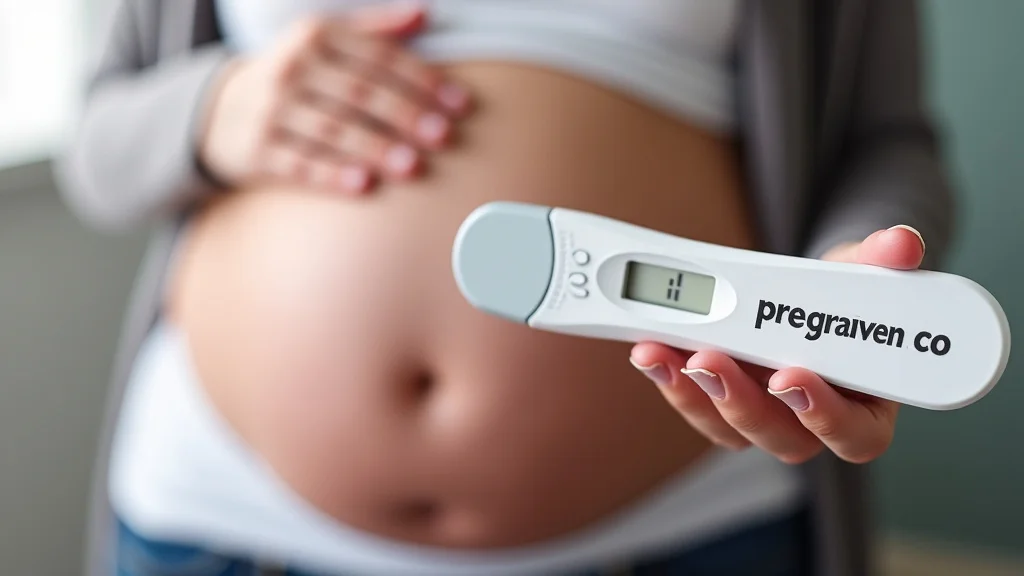
Getting a positive pregnancy test is a big moment. For many, the next big question is “How far along am I?” This is where pregnancy tests that tell you how many weeks come in. They seem like magic, but they can be a little confusing when you first see them.
You might wonder how they work or if they’re really accurate. Don’t worry! This guide will break it all down super simply.
We’ll go step-by-step so you can feel confident. Let’s get started on finding out your early pregnancy stage.
Key Takeaways
- You can learn how far along your pregnancy is with certain tests.
- These tests detect a hormone that increases as pregnancy progresses.
- Different tests have different ways of showing your weeks.
- Understanding how they work helps you trust the results.
- These tests offer early insights into your pregnancy timeline.
- Accuracy depends on when you test and the specific product.
Understanding Weeks-Estimating Pregnancy Tests
When you first find out you’re pregnant, one of the most exciting questions is “How many weeks pregnant am I?” This is where weeks-estimating pregnancy tests become super helpful. They are designed to give you a bit more information than a standard test. Instead of just a positive or negative result, some tests can estimate how many weeks have passed since conception.
This can be really useful for planning your first doctor’s visit and thinking about when your baby might arrive.
These tests work by detecting a hormone called human chorionic gonadotropin (hCG). This hormone is produced by the placenta shortly after conception. The amount of hCG in your body increases rapidly in the early weeks of pregnancy.
Weeks-estimating tests use different methods to measure this hormone. Some detect different levels of hCG, while others use technology to show a numerical result.
How Do These Tests Work
The magic behind weeks-estimating pregnancy tests is all about hCG. This is the hormone that your body makes only when you are pregnant. Right after a fertilized egg implants itself in your uterus, your body starts making hCG.
The amount of this hormone goes up really fast, doubling about every two to three days in the first few weeks.
Weeks-estimating tests are built to spot these rising hCG levels. They have special strips or indicators that change color or show symbols based on how much hCG they find. Think of it like a built-in measuring cup for hCG.
The more hCG there is, the further along the test suggests the pregnancy might be. This is why it’s important to test at the right time for the most accurate results.
Detecting hCG Levels
The key to knowing how many weeks pregnant you are is by measuring the hCG hormone. Pregnancy tests that tell you how many weeks use a special chemical that reacts with hCG. When hCG is present in your urine, it causes a reaction.
Different tests are calibrated to react differently to varying concentrations of hCG.
For example, a test might have different zones or lines that light up. Each zone corresponds to a certain range of hCG. A low level might indicate a very early pregnancy, perhaps only a few weeks.
A higher level could mean you are further along, maybe several weeks past your last period. The test’s packaging usually explains how to read these results.
The Role of the Last Menstrual Period (LMP)
Doctors often calculate pregnancy duration using your last menstrual period, or LMP. This is the first day of your last period. Pregnancy is counted in weeks starting from that date.
So, if your last period was three weeks ago, you are considered three weeks pregnant by your doctor, even though conception likely happened about two weeks ago.
Weeks-estimating pregnancy tests try to mimic this dating method. They don’t actually know when your last period was. Instead, they estimate based on the hCG levels they detect.
Because hCG levels rise predictably, the tests can make an educated guess about how many weeks have passed since conception, which is usually close to the LMP dating.
Why LMP is Important
Your LMP is important because it gives a standard starting point for pregnancy. It’s like the official birthday of your pregnancy in the eyes of healthcare providers. Most pregnancies are considered to be about 40 weeks long, counted from the first day of your LMP.
This is a widely accepted method that doctors use.
Knowing your LMP helps you compare the test result to what your doctor might tell you. It also helps you understand the timeline of your pregnancy. This information is useful for tracking milestones and knowing when to expect certain developments.
Types of Weeks-Estimating Pregnancy Tests
There are a few different kinds of pregnancy tests that can give you an idea of how many weeks pregnant you are. They all use the same basic idea – measuring hCG – but they show the results in various ways. Knowing what to expect from each type can help you choose the best one for you.
Some tests give a digital readout, showing the number of weeks clearly. Others might use lines or symbols. Each type has its own advantages, and it’s good to know what they are before you buy one.
Digital Tests
Digital pregnancy tests are often the easiest to read. When you take one and it detects hCG, the screen will show a clear message. For example, it might say “Pregnant” and then, if it’s a weeks-estimating digital test, it will also show a number like “1-2 weeks,” “2-3 weeks,” or “3+ weeks.” This direct number makes it very simple to know your estimated gestational age.
These tests are generally more expensive than basic strip tests. However, the clarity of the results can be worth the extra cost, especially when you’re eager for information. They are designed to be user-friendly, minimizing confusion about the results.
How Digital Tests Display Weeks
Digital weeks-estimating tests are quite clever. They contain a sensor that reads the hCG level in your urine. Based on the amount of hCG detected, a small computer chip inside the test interprets this information.
It then displays the estimated number of weeks since conception on the digital screen.
For instance, if the hCG level is in a certain range, the test might show “1-2 weeks pregnant.” If the hCG level is significantly higher, it might show “2-3 weeks pregnant.” The highest reading typically is “3+ weeks,” meaning the hCG level is high enough to indicate a pregnancy of three weeks or more from conception.
Non-Digital or Line-Based Tests
Some pregnancy tests that estimate weeks don’t have a digital screen. Instead, they use lines or symbols. These tests might show a result like “Less than 3 weeks,” “3+ weeks,” or even provide a range of weeks using different colored lines.
You have to read the result based on a chart or instructions provided with the test kit.
These can be a bit trickier to interpret at first compared to digital tests. You need to pay close attention to the packaging to understand what each line or symbol means. However, they can be more affordable and still offer valuable information about your pregnancy stage.
Interpreting Line Results
For line-based weeks-estimating tests, the interpretation relies on how the hCG hormone interacts with the test’s chemical indicators. Typically, these tests will have a control line, which shows the test is working, and one or more test lines. The intensity and number of test lines can help determine the weeks.
Some tests might use a different system. For example, a test could have a special indicator that changes color or forms a specific shape if a certain hCG threshold is met. The instructions are key here.
They will usually include a diagram showing what different line combinations or symbols mean in terms of weeks pregnant. Always refer to the leaflet that comes with your specific test.
Accuracy and Timing for Weeks-Estimating Tests
When you’re using pregnancy tests that tell you how many weeks, accuracy is a big deal. You want to be sure the information you’re getting is reliable. The best way to ensure accuracy is to follow the test’s instructions carefully and to test at the right time in your pregnancy.
Testing too early can lead to incorrect results, no matter how advanced the test is. It’s all about catching enough of that crucial hCG hormone. So, timing is really everything with these tests.
When to Take a Weeks-Estimating Test
For the most accurate results from a weeks-estimating pregnancy test, it’s best to wait until after your missed period. Some highly sensitive tests might detect hCG a few days before your missed period, but their accuracy for estimating weeks is generally better a bit later.
The hCG levels rise steadily in early pregnancy. Testing too soon means there might not be enough hCG for the test to accurately measure the weeks. Waiting until you are at least one day past your expected period significantly increases the chances of getting a reliable reading, both for pregnancy confirmation and for the weeks estimate.
The Importance of Testing at the Right Time
Testing at the right time is crucial because hCG levels need to reach a certain point for the test to work effectively. If you test too early, you might get a “false negative” – meaning the test says you’re not pregnant when you are. Or, if the test is meant to estimate weeks, you might get an inaccurate week count.
For weeks-estimating tests, testing around or after your missed period allows for higher hCG concentrations. This makes it easier for the test’s sensors to differentiate between various hCG levels that correspond to different stages of early pregnancy, leading to a more accurate week estimate.
Factors Affecting Accuracy
Several factors can influence how accurate your weeks-estimating pregnancy test is. One of the most important is the sensitivity of the test itself. Some tests are more sensitive to hCG than others, meaning they can detect lower amounts of the hormone.
Another factor is how you use the test. Following the instructions precisely, like how long to dip the test stick or how long to wait for results, is essential. Even something like drinking too much fluid right before testing can dilute your urine, potentially affecting hCG concentration and the test’s accuracy.
Test Sensitivity Levels
Test sensitivity is measured in milli-International Units per milliliter (mIU/mL). This number tells you the lowest amount of hCG a test can detect. A lower mIU/mL number means the test is more sensitive and can detect pregnancy earlier or estimate weeks more accurately in the very early stages.
For example, a test with a sensitivity of 10 mIU/mL can detect pregnancy sooner than a test with a sensitivity of 25 mIU/mL. When choosing a weeks-estimating test, look for information on its sensitivity. Higher sensitivity tests are generally better for early detection and more precise week estimation.
Proper Test Usage
Using the pregnancy test correctly is as important as the test’s sensitivity. Always read the instructions that come with your specific test. They will tell you exactly what to do.
This includes things like when to collect your urine sample (first morning urine is often recommended because hCG is more concentrated then), how long to hold the test in the urine stream, and how long to wait before reading the result.
If you skip a step or rush the process, you might get an incorrect reading. For weeks-estimating tests, this could mean an inaccurate number of weeks. Patience and following directions are key to getting the most reliable information from your test.
Common Myths Debunked
Myth 1: All Pregnancy Tests Estimate Weeks
This is not true. Standard home pregnancy tests only tell you if you are pregnant or not. They do not provide any information about how far along your pregnancy is.
Only specific “weeks-estimating” or “digital” pregnancy tests are designed to give an indication of gestational age.
The reality is that only certain types of tests are engineered with the technology to measure different concentrations of hCG. These concentrations correlate with the progression of early pregnancy. Basic tests are programmed to simply detect the presence of hCG above a certain threshold, not to quantify it for week estimation.
Myth 2: Weeks-Estimating Tests Are 100% Accurate
While weeks-estimating tests are very helpful, they are not always 100% accurate for determining your exact number of weeks. They provide an estimate based on hCG levels, which can vary slightly from person to person. Factors like when you ovulate or if you have irregular cycles can affect the timing.
The reality is that these tests offer a good approximation, especially when used correctly and at the right time. Your doctor’s calculation, often based on your last menstrual period and confirmed with an ultrasound, is considered the most definitive way to date a pregnancy.
Myth 3: You Can Use Any Pregnancy Test for Week Estimation
This is a common misunderstanding. Many people believe any positive pregnancy test can reveal the weeks. However, only specific brands and types of tests are made with the capability to estimate weeks.
These often have a digital display or a special marking system on the test stick itself.
The reality is that regular line tests or simple digital tests that only say “Pregnant” or “Not Pregnant” do not have the necessary internal mechanism to measure the specific hCG ranges required for week estimation. You must purchase a test that explicitly states it can estimate the number of weeks pregnant.
Myth 4: A Weeks-Estimating Test Can Replace a Doctor’s Visit
No, a weeks-estimating pregnancy test is a home tool for early information and should never replace professional medical advice. While it can give you a good idea of how far along you are, it doesn’t provide a medical diagnosis or the comprehensive care you’ll receive from a healthcare provider.
The reality is that your doctor will perform their own assessments, which may include dating your pregnancy through ultrasound. These tests are supplementary and meant to offer preliminary insights, not to substitute for essential prenatal care and medical expertise.
Frequently Asked Questions
Question: How soon can a pregnancy test tell me how many weeks
Answer: Many weeks-estimating pregnancy tests can provide an estimate as early as six days before your missed period. However, for the most accurate results, it is recommended to wait until one day after your missed period.
Question: Can I reuse a pregnancy test that tells me how many weeks
Answer: No, pregnancy tests are designed for single use only. Reusing a test can lead to inaccurate results, as the chemical indicators will have already reacted and are not reliable for a second reading.
Question: What does “3+ weeks” mean on a pregnancy test
Answer: “3+ weeks” on a pregnancy test indicates that the hCG level detected is high enough to suggest you are at least three weeks pregnant from conception, or approximately five weeks pregnant from your last menstrual period. It means the test has reached its highest detection range.
Question: Are weeks-estimating tests reliable for irregular cycles
Answer: Weeks-estimating tests can be less reliable for individuals with irregular menstrual cycles. Since the estimation is based on hCG levels that correlate with time since conception, an unpredictable cycle can make it harder to pinpoint an accurate number of weeks.
Question: Should I call my doctor after using a weeks-estimating test
Answer: Yes, you should always contact your doctor after getting a positive pregnancy test, even if it estimates your weeks. Your doctor will confirm the pregnancy, discuss your health, and provide guidance on prenatal care.
Conclusion
Using pregnancy tests that tell you how many weeks can offer exciting early insight. These tests measure hCG to estimate your gestational age. Remember to test after your missed period for better accuracy.
Digital and line tests both work well if used correctly according to instructions. Consult your doctor for definitive dating and care.
Leave a Reply