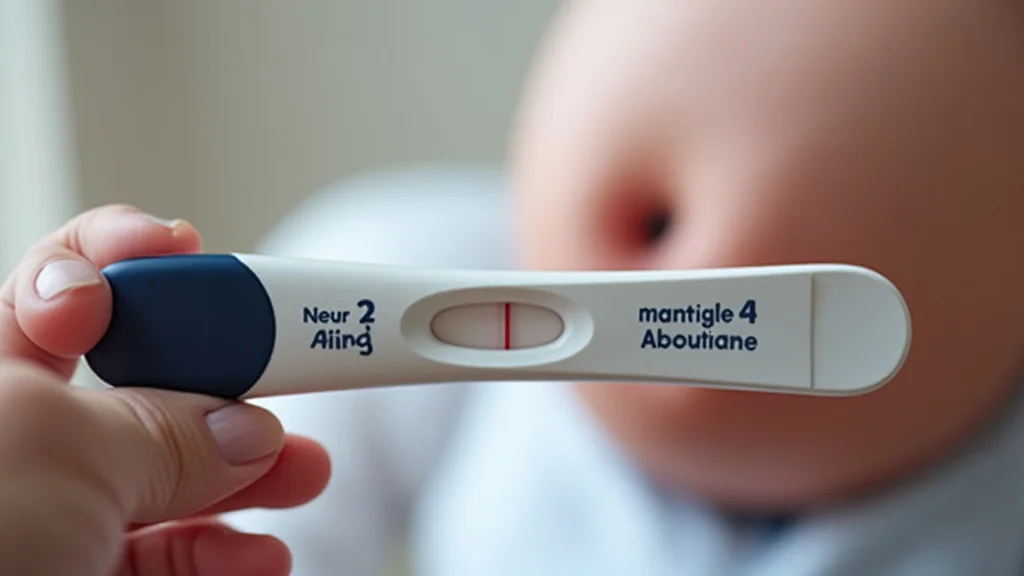
Seeing two lines on a pregnancy test can be exciting, but what if one line is super faint? This is super common, especially if you’re testing early. It can make you wonder if it’s a positive result or not.
Don’t worry, this post will make it clear. We’ll walk through what a faint line means and what you should do next, step-by-step. Get ready to have your questions answered simply and easily.
Key Takeaways
- A faint positive line on a pregnancy test usually means you are pregnant.
- The faintness often indicates low levels of hCG in your urine.
- Testing too early or with diluted urine can cause a faint line.
- Retesting after a few days or confirming with a doctor is recommended.
- Different test brands may show faint lines with varying intensity.
What a Faint Line Really Means
When you look at a pregnancy test and see two lines, but one is very faint, it’s a sign that your body might be producing the pregnancy hormone called hCG. This hormone, human chorionic gonadotropin, is what pregnancy tests detect. When a fertilized egg implants in your uterus, your body starts making hCG.
The amount of hCG usually doubles about every 48 to 72 hours in early pregnancy. So, a faint line suggests that there’s some hCG present, but perhaps not a very high amount yet.
This is especially common when you take the test very early in your pregnancy, before your hCG levels have had a chance to rise significantly. It can also happen if the test was exposed to too much liquid, like if you held it in the stream for too long, or if your urine was very diluted because you drank a lot of fluids before testing. These factors can affect how clearly the second line appears.
Why Faint Lines Appear
Pregnancy tests work by detecting hCG in your urine. They have a special strip that reacts to this hormone. If there’s enough hCG, the strip changes color, showing a positive result.
When the line is faint, it means there’s hCG, but the concentration is low. This low concentration can be due to several reasons. The most frequent reason is testing too early in the pregnancy.
Your hCG levels might just be starting to climb.
Another reason could be the sensitivity of the test itself. Some tests are more sensitive than others and can detect lower levels of hCG. If you are using a less sensitive test, you might need a higher hCG level to get a clear second line.
Also, the time of day you test matters. First-morning urine is usually the most concentrated, meaning it will have the highest hCG levels, making a faint line more likely to show up as a clear positive later on.
Factors Affecting Line Intensity
Several factors influence how dark or faint a line appears on a pregnancy test. The amount of hCG in your urine is the primary driver. If hCG levels are just starting to rise, the line will be faint.
As pregnancy progresses and hCG levels increase, the line will become darker. This is why retesting after a few days is often recommended; you’ll see if the line gets darker, indicating a progressing pregnancy.
The type of pregnancy test you use also plays a role. Digital tests often give a simple “Pregnant” or “Not Pregnant” result, removing the ambiguity of faint lines. However, traditional line tests can vary in their sensitivity.
Some are designed to detect very low levels of hCG, which might result in a faint line even at an early stage. The timing of the test is also critical. Testing on the day your period is due or a few days after will yield more accurate results than testing very early.
Hydration levels are another significant factor. If you drink a lot of water before taking the test, your urine will be more diluted. This can dilute the hCG concentration, leading to a fainter line, even if you are pregnant.
For this reason, healthcare providers often suggest using your first-morning urine, as it’s typically the most concentrated.
Early Pregnancy and hCG Levels
Understanding hCG levels is key to interpreting a faint line. After conception, hCG is produced by the cells that will eventually form the placenta. It enters your bloodstream and then your urine.
Within days of implantation, hCG can be detected. However, the amount is very small at first. For example, at around 10 days after ovulation, hCG levels might be between 2 and 50 mIU/mL.
Most home pregnancy tests can detect hCG at levels of 20-25 mIU/mL or higher.
So, if you test at 10-12 days past ovulation, and your hCG is just starting to increase, you might see a faint line. As your pregnancy advances, hCG levels can rise rapidly. By 14 days past ovulation, levels might be between 50 and 100 mIU/mL, and by 21 days, they could be 200-1000 mIU/mL or more.
This increase in hCG is why a second line becomes progressively darker on subsequent tests if the pregnancy is progressing normally.
The Role of Diluted Urine
When you take a pregnancy test, you want the highest concentration of hCG possible in your urine. If you drink a large amount of water right before testing, you dilute your urine. Imagine adding a lot of water to a glass of juice; the flavor becomes less intense.
Similarly, adding a lot of water to your urine dilutes the hCG, making it harder for the test to detect and show a strong line. This is why many test instructions advise against drinking excessive fluids before testing.
This dilution effect can be particularly misleading in early pregnancy when hCG levels are naturally low. A test taken with diluted urine might show no line or a very faint line, even if pregnancy has occurred. This is why it’s often best to test with your first-morning urine.
This urine has been concentrated overnight, meaning any hCG present will be at its highest concentration, increasing the chances of a clear positive result if you are pregnant.
Common Scenarios with Faint Lines
Let’s look at a couple of situations where a faint line might appear. Sarah is trying to get pregnant and takes a pregnancy test 10 days after she thinks she ovulated. She sees a very faint second line.
She’s unsure if this means she’s pregnant. This is a very common scenario. Her hCG levels are likely just starting to rise.
If she waits two days and tests again, the line might be much darker. This shows her hCG has increased.
Another example is Maria. She took her test after drinking a big bottle of water. She gets a faint line.
Later that day, after not drinking for a few hours, she takes another test. This time, the second line is much clearer and darker. This demonstrates how hydration can impact the test result.
It’s important to remember that even a faint line is often a positive result.
Scenario 1 Waiting to Test
Imagine you’re eagerly waiting to find out if you’re pregnant. You might be tempted to test as soon as possible. Home pregnancy tests are most accurate on or after the first day of your missed period.
If you test before this, your hCG levels may not be high enough to produce a strong, visible line. So, you might see a very faint line. This is often a sign of a chemical pregnancy, which is a very early miscarriage, or simply that it’s too early to detect.
For instance, if a woman tested 5 days before her expected period, and she got a faint positive, it’s very likely her hCG is low. By waiting a few days, say until her missed period, her hCG levels would have likely doubled. This increase would then show up as a clearer, darker line on the test.
Patience is key when interpreting early results, and following the test’s instructions regarding when to test is crucial.
Scenario 2 Using Different Brands
You might use one brand of pregnancy test and see a faint line. Then, you decide to use a different brand to confirm, and that one shows a clearer line, or perhaps no line at all. This can happen because different brands have different sensitivities.
Some tests are designed to detect lower levels of hCG than others. A very sensitive test might pick up a faint line at an early stage when a less sensitive test would still show a negative result.
For example, Brand A might have a sensitivity of 20 mIU/mL of hCG, while Brand B has a sensitivity of 25 mIU/mL. If your hCG level is 22 mIU/mL, Brand A might show a faint line, while Brand B would not show a line. This doesn’t necessarily mean you aren’t pregnant with Brand B; it just means your hCG level wasn’t high enough to be detected by that specific test’s sensitivity.
Using a digital test can often avoid this confusion as they provide a clear word result.
Interpreting Your Test Results
When you see that faint line, it’s important to stay calm and interpret it correctly. A faint line on a pregnancy test usually indicates a positive result. The intensity of the line is related to the amount of hCG in your urine.
A faint line means there is hCG present, but in a lower concentration than what would produce a dark, obvious line. This is often seen in very early pregnancy.
However, it’s also important to consider how long you’ve waited to take the test and the instructions that came with it. Some tests can show a “faint positive” if they are read after the recommended time window. This is called an evaporation line, which is a colorless mark that can appear when urine evaporates from the test strip after the result is no longer valid.
Always read the test within the specified time frame.
The Evaporation Line Factor
Evaporation lines are a common source of confusion with pregnancy tests. These lines appear when urine on the test strip begins to dry and evaporate. They are typically colorless or very pale gray and can sometimes be mistaken for a faint positive line.
The key difference is that evaporation lines usually appear after the designated reading time. Most pregnancy tests have a window of about 5-10 minutes for accurate results.
If you check the test after, say, 30 minutes, and see a faint line, it’s likely an evaporation line. This happens because as the urine dries, it can leave behind a faint residue that mimics a positive line. To avoid this confusion, always follow the test’s instructions precisely regarding when to read the result.
If you’re unsure, it’s best to take another test later or a different brand.
What to Do Next
So, you’ve seen a faint line. What’s the next step? The most recommended action is to retest.
Wait a day or two and take another pregnancy test, preferably with your first-morning urine. This allows your hCG levels to increase, which should result in a darker, clearer line if you are pregnant. You can use the same brand or a different one, or even consider a digital test for a straightforward answer.
Another crucial step is to schedule an appointment with your doctor or a healthcare provider. They can perform a blood test, which is more sensitive and can detect hCG levels earlier and more accurately than urine tests. A doctor can also confirm your pregnancy and discuss the next steps for prenatal care.
They can also help rule out any other potential causes for unusual test results.
Factors Influencing Test Sensitivity
The sensitivity of a pregnancy test refers to the lowest level of hCG it can detect. This is usually measured in milli-international units per milliliter (mIU/mL). A more sensitive test has a lower mIU/mL detection limit, meaning it can detect pregnancy earlier.
For example, a test with a sensitivity of 10 mIU/mL will detect hCG at a lower level than a test with a sensitivity of 25 mIU/mL.
This difference in sensitivity is a major reason why you might get different results or line intensities from different brands. It’s also why testing too early can lead to faint lines. Your hCG levels simply haven’t reached the detection threshold of the test yet.
Understanding test sensitivity can help you choose the right test and interpret your results more accurately.
Comparing Test Sensitivities
When you look at pregnancy test packaging, you might see information about sensitivity, often listed as the mIU/mL detection level. For example, some tests advertise as “early detection” and might have a sensitivity of 10 or 15 mIU/mL. Standard tests might be around 20 or 25 mIU/mL.
More sensitive tests are better for detecting pregnancy in the days leading up to a missed period, but they can also be more prone to showing faint lines if your hCG is just beginning to rise.
Here’s a simple comparison table:
| Test Sensitivity (mIU/mL) | Likely Detection Timeframe | Result with Low hCG |
|---|---|---|
| 10-15 | Up to 6 days before missed period | Likely faint positive if pregnant |
| 20-25 | Around missed period | May show faint positive or negative |
| 30-50 | After missed period | Likely clear positive if pregnant |
This table shows how a test with higher sensitivity can detect pregnancy earlier. However, it also highlights why a faint line might appear with lower hCG levels using a more sensitive test.
How Dilution Affects Sensitivity
Even with a highly sensitive test, diluted urine can mask a positive result. If your hCG level is, for example, 20 mIU/mL, and you are using a 10 mIU/mL sensitive test, you should get a positive result. However, if you drink a lot of water beforehand, your urine might become so diluted that the effective hCG concentration drops to, say, 8 mIU/mL.
In this case, even the sensitive test might not detect it, showing a negative result or a very, very faint line that might be missed.
This is why it’s always best to use your first-morning urine when taking a pregnancy test, especially if you are testing early or if you’ve had ambiguous results. First-morning urine is the most concentrated, ensuring that any hCG present is in its highest concentration for that day, giving the test the best chance to detect it accurately.
When to Seek Medical Advice
If you’ve taken a pregnancy test and are still unsure about the result, or if you have a history of pregnancy complications, it’s always wise to consult a healthcare professional. They can provide definitive testing and guidance. A doctor can confirm your pregnancy with a blood test and discuss your options and next steps.
Persistent faint lines, or a situation where you continue to get faint positive results over several days, might warrant a discussion with your doctor. While often indicating early pregnancy, in rare cases, it could be related to other hormonal factors or conditions. Seeking professional medical advice ensures you have accurate information and appropriate care.
Confirming Pregnancy with a Doctor
A doctor’s visit is the most reliable way to confirm a pregnancy. They can perform two main types of tests: a urine test (similar to at-home tests, but often more sensitive) and a blood test. Blood tests are considered more accurate, especially in the early stages of pregnancy.
There are two types of blood tests: qualitative, which simply detects the presence of hCG, and quantitative, which measures the exact amount of hCG in your blood.
A quantitative blood test is particularly useful. As mentioned, hCG levels typically double every 48-72 hours in early pregnancy. By measuring the hCG level, a doctor can get a good idea of how far along the pregnancy is and monitor its progression.
This can help rule out any concerns and provide peace of mind.
Possible Reasons for Unusual Results
While a faint line is most commonly a sign of early pregnancy, there can be other reasons for unusual test results. One is indeed an evaporation line, as discussed earlier, which occurs when a test is read too late. Another is taking the test too early, before hCG levels are high enough to be clearly detected.
Some medications containing hCG, such as those used in fertility treatments, can also cause a false positive result.
Less common reasons can include certain medical conditions that affect hormone levels, or very rarely, a type of pregnancy called a molar pregnancy, which involves abnormal growth of the placenta and can produce very high hCG levels. These are rare, but they are reasons why a doctor’s confirmation is always recommended.
Common Myths Debunked
Myth 1: A faint line means you’re not really pregnant.
Reality: A faint line usually indicates that hCG is present in your urine, meaning you are likely pregnant. The faintness simply suggests lower hCG levels, common in early pregnancy or when testing before a missed period. It’s a positive sign, though often requires retesting to confirm.
Myth 2: Only cheap pregnancy tests give faint lines.
Reality: The cost of a pregnancy test doesn’t determine the intensity of the line. Faint lines are related to hCG levels and test sensitivity, not price. Expensive tests can also show faint lines if hCG levels are low, and vice versa.
Myth 3: If you get a faint line, it’s definitely a chemical pregnancy.
Reality: While a faint line can sometimes be associated with a chemical pregnancy (a very early miscarriage), it is most often a sign of a healthy, progressing early pregnancy. The best way to know is to retest and consult a doctor.
Myth 4: You can’t get pregnant if your test shows one faint line.
Reality: The presence of a faint line, even if lighter than the control line, typically signifies a positive result. It means hCG has been detected. It is not a negative result.
Frequently Asked Questions
Question: What if my pregnancy test has two faint lines
Answer: If your pregnancy test shows two faint lines, it usually means you are pregnant. Both lines indicate the presence of hCG, but at lower levels. Retesting in a day or two is recommended to see if the lines become darker.
Question: Can drinking a lot of water affect a faint line
Answer: Yes, drinking a lot of water before taking a pregnancy test can dilute your urine. This might make a faint line appear even fainter or disappear altogether, potentially leading to a false negative result.
Question: How long after implantation can a faint line appear
Answer: A faint line can appear as early as 10-12 days after ovulation, which is when implantation typically occurs and hCG levels begin to rise. However, it’s more common to see a clearer line closer to your missed period.
Question: Should I take another pregnancy test if I see one faint line
Answer: Absolutely. If you see one faint line, it’s highly recommended to take another test a day or two later, preferably with first-morning urine. This will help confirm the result as hCG levels increase.
Question: Are digital pregnancy tests better for faint lines
Answer: Digital pregnancy tests offer a clear “Pregnant” or “Not Pregnant” result, eliminating the ambiguity of faint lines. They are a good option if you want a straightforward answer, though they may not detect pregnancy quite as early as some sensitive line tests.
Summary
Seeing a faint line on a pregnancy test, like pregnancy test 2 lines but one very light, often means you are pregnant. The faintness usually points to early stages of pregnancy with lower hCG levels. Retesting after a few days, especially with first-morning urine, is the best next step.
Confirming with your doctor offers the most certainty and allows for proper care. Trust that a faint line is most often a positive sign.
Leave a Reply